
#3 | The missing "Step 0"
Why AI gives you generic advice

You understand why focus matters. In Post #2 you’ve seen what Jobs did with the 2×2 grid. Now you open ChatGPT to help prioritize your week. It gives you advice that could apply to any founder, anywhere, at any stage. You close the tab and go back to your gut.
Here’s why that keeps happening.
The Amnesia Problem
Every AI conversation starts from zero. The model doesn’t know your runway is 8 months, not 3 years. It doesn’t know your churn rate is 40%, not 4%. It doesn’t know a competitor just undercut your pricing by 30%.
It treats you like “a founder” instead of you — the founder of your specific company, with your specific constraints, in your specific moment.
Imagine hiring a brilliant consultant who forgets everything about your business every Monday morning. You’d fire them. But that’s exactly what happens every time you open a fresh chat. And you tolerate it!
This isn’t an AI limitation. It’s a context problem.
Why context changes everything
When you send a prompt to an AI, you’re not having a conversation. You’re handing it a single snapshot and asking it to respond. Everything inside that snapshot is all the AI knows. Everything outside it doesn’t exist.
Most people write prompts like this:
“Help me prioritize my week.”
The AI sees five words. No company. No constraints. No stakes. So it treats you as a “generic founder asking generic question” and gives you generic advice.
But when your prompt carries context:
“Help me prioritize my week. [Context: Series A SaaS, $500K ARR, 8-month runway, competitor just undercut pricing 30%, board meeting in 2 weeks]”
Now the AI sees a specific situation. It can’t give you generic advice — the constraints won’t allow it. The response has to speak to your reality.
This is what engineers call “context engineering.” Not prompt tricks. Not magic words. Just making sure the AI sees what you see before it tries to help.
The problem? Manually adding context to every prompt is exhausting.
You won’t do it. Nobody does. So you default to five-word prompts and wonder why the output feels hollow.
Under the Hood: The Physics of Context
“Context Engineering”. It’s not about “magic words.” It’s about mathematical precision. When you provide context, you’re fundamentally changing the “physics” of how the AI thinks.
Three things happen inside the neural networks:
The Magnetism of “Attention Weights”: Inside the AI is a process called Self-Attention. Think of it as Mathematical Gravity. When you ask a generic question, the words have no “weight.” But when you add context like “8-month runway,” those words act like high-gravity anchors. The AI is forced to “attend” to your constraints first, pulling its logic away from generic fluff.
Collapsing the Probability Space: AI is a prediction engine. Without context, it looks at the entire world of data and takes the path of least resistance — High Entropy. By adding context, you are physically building Probability Guardrails. The AI isn’t “thinking”; it is calculating the narrowest possible path that satisfies all your constraints. You are grounding AI feedback to your reality.
GPS Coordinates in Vector Space: Think of the AI’s total knowledge as a massive map. A generic prompt lands you in the “Average Advice” neighborhood. Context Engineering acts as a set of GPS Coordinates, teleporting the AI to a tiny, elite neighborhood: “Stressed SaaS Founder with a Pricing Crisis.” At this point all the generic advice is no longer an option.
What changes everything: the Context Vault
The Context Vault solves this by front-loading the work. You fill it out once — like onboarding a Chief of Staff who never forgets. Then every prompt you run carries your business reality automatically. No copy-pasting. No re-explaining. The context just travels with you.
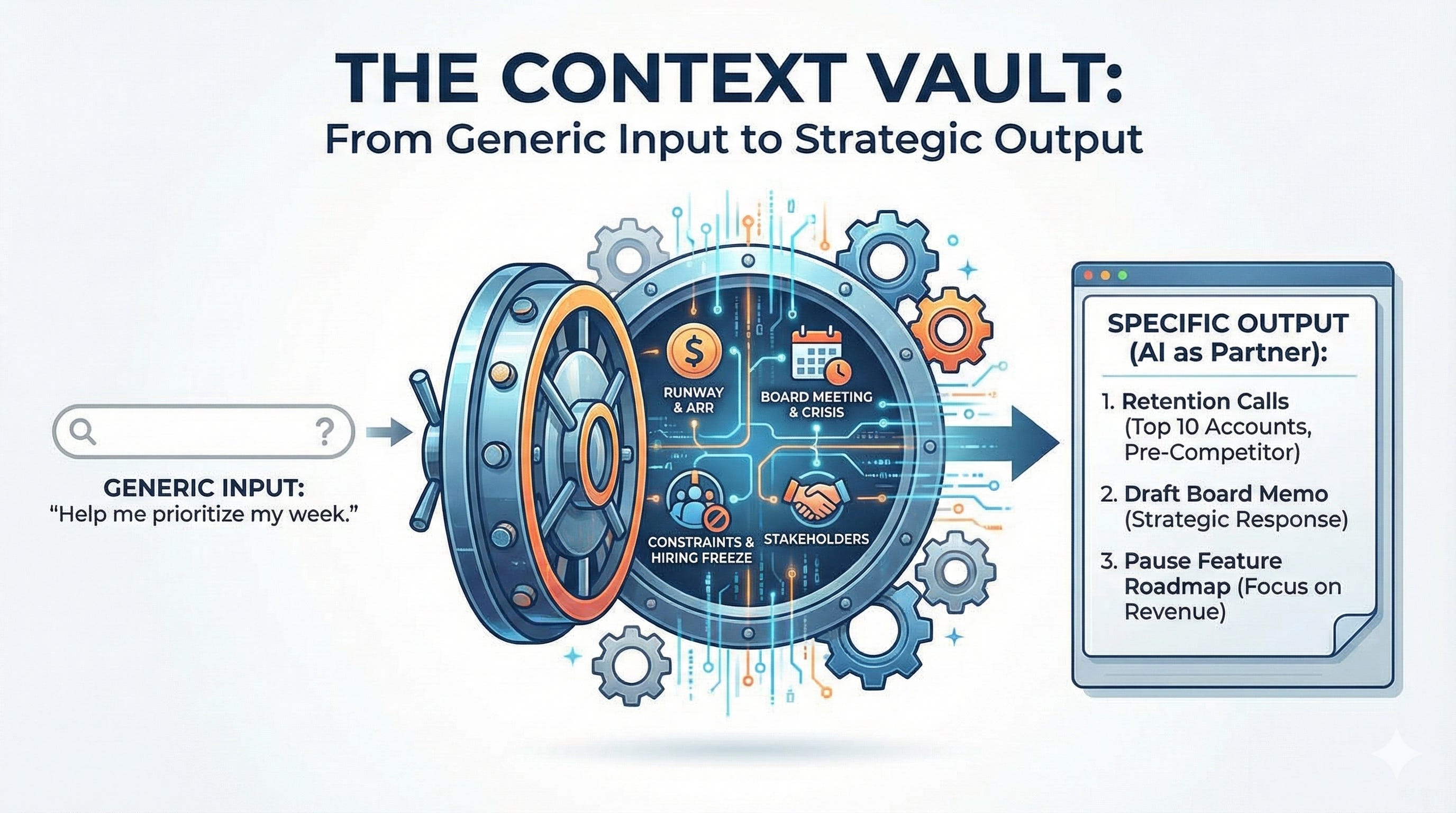
The Vault captures five layers:
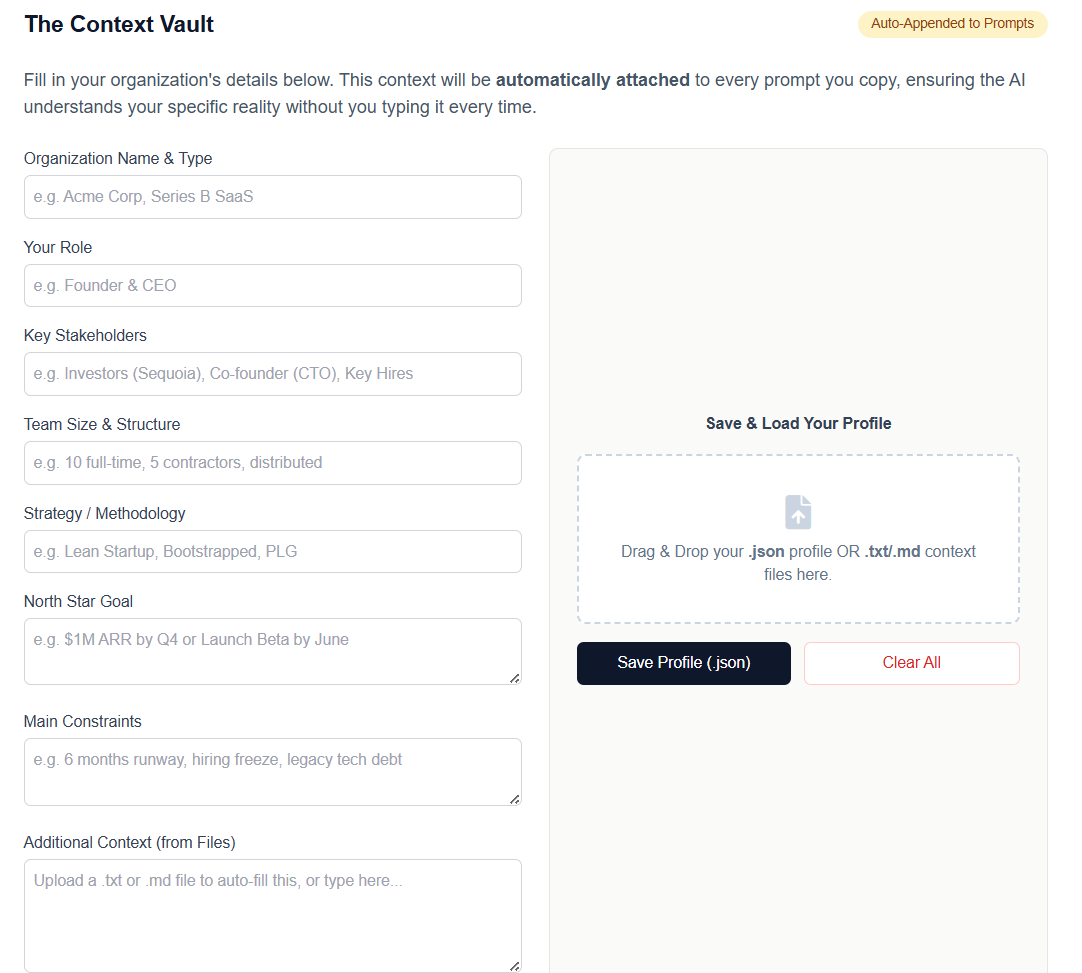
1. Identity Your company name, stage, industry, and your role. (”Acme Corp, Series A B2B SaaS, Founder & CEO”)
2. Strategy Your North Star metric and current methodology. (”$1M ARR by Q4, product-led growth”)
3. Constraints The walls you’re operating within. Runway, team size, hiring freezes, technical debt, known blockers. (”8 months cash, 12 FTEs, no new hires until Q3”)
4. Stakeholders The people who shape your decisions. Co-founders, key investors, board members. (”CTO co-founder, lead investor at Sequoia”)
5. Live Context What’s happening right now. Recent wins, active crises, strategic pivots, upcoming deadlines. (”Competitor launched at 30% lower price last week. Board meeting in 14 days.”)
When the Vault is active, you stop explaining and start asking.
The difference in practice
Without the Vault:
You: “Help me prioritize my week.”
AI: “Consider using the Eisenhower matrix to separate urgent from important tasks. Block time for deep work in the mornings. Batch your emails...”
Generic. Forgettable. Already heard it.
With the Vault:
You: “Help me prioritize my week.”
[Context auto-appends: Series A SaaS, $500k ARR, 8-month runway, 12-person team, hiring freeze, competitor launched at 30% lower price, board meeting in 14 days]
AI: “Given your runway and the pricing threat, this week has three priorities: (1) Retention calls with your top 10 accounts to lock in renewals before they see the competitor. (2) Draft a board memo framing your response strategy—they’ll want to see you’re not reactive. (3) Pause the feature roadmap review; it’s noise until you’ve stabilized revenue. Everything else waits.”
Same prompt. Completely different output. The context forces specificity.
The foundation for everything else
Think of the Context Vault as your company’s “Single Source of Truth.”
It is the engine that makes the Ruthless Focus System — and any other that will follow — actually work. Because these systems plug directly into the Vault, they stop being generic frameworks and start being personalized strategies.
They aren’t guessing who you are — they already know.
This is the line in the sand: without the Vault, you’re using AI like a search engine.
With it, you’re using AI like a strategic partner who’s done the pre-reading.
Below a peek-sneak into the Contaxt Vault build into each system.
What’s coming next
Ten frameworks that turn “everything feels urgent” into “I know exactly what matters this week.” This is “Jobs’ 2×2 grid” operationalized — a system for killing good ideas so your great ideas can breathe.
I’m giving the Ruthless Focus System free to 10 readers who’ll actually use it. Not collectors — implementers. If you want it, DM me with what you’re building and why you’re stuck. I’ll pick 10 and send everything.
Stay focused,
Corrado
P.S. — Know founders, practitioners and team leaders drowning in “reasonable priorities”? Forward this to them. They’ll thank you when their AI stops giving generic advice.