
#7 | The Clarity Advantage
Lessons in Strategic Communication from Reed Hastings

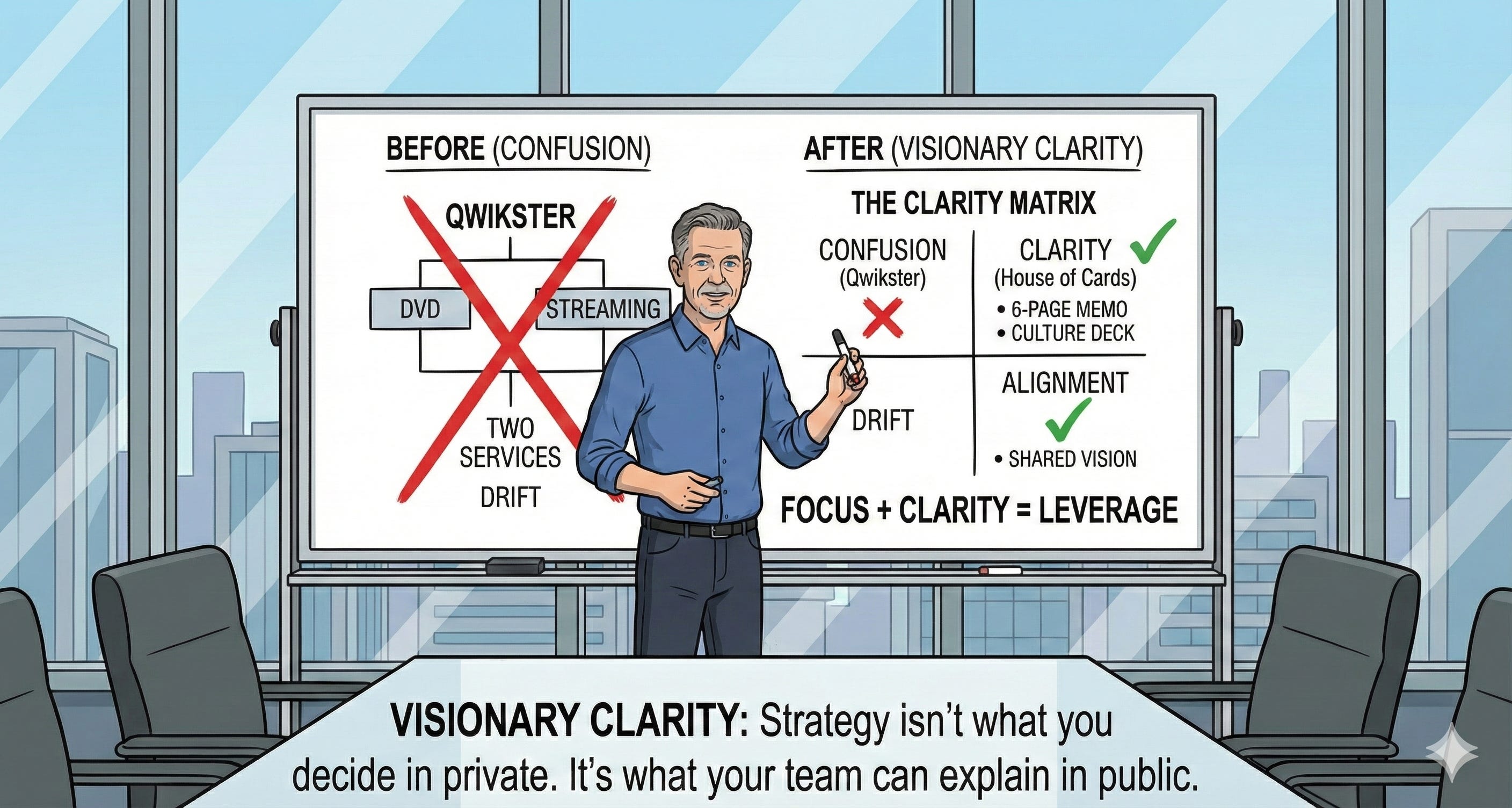
Focus without clarity is disciplined confusion.
You can execute flawlessly on the wrong strategy.
You can move fast in a direction that drifts.
You can scale a company no one fully understands - including your own team.
This is the second pillar of founder leverage: Visionary Clarity.
And few founders learned it more painfully than Reed Hastings.
The pivot that nearly broke Netflix
Everyone knows the Netflix origin story. DVDs by mail. Then streaming. Then global dominance. What most people forget is that the most important transition almost imploded the company.
In 2011, Netflix announced Qwikster - a plan to split its DVD-by-mail business from streaming into two separate companies. Two brands. Two websites. Two bills. The reaction was brutal.
Within months:
Nearly a million subscribers left.
The stock price collapsed by roughly 77%.
Hastings publicly apologized.
The plan was reversed within three weeks.
On the surface, it looked like executive incompetence. It wasn’t. It was a communication failure.
Logic was sound. Communication wasn’t.
Internally, Qwikster made strategic sense. DVDs were a declining, logistics-heavy business. Streaming was the future—scalable, global, margin-rich. Separating them would:
Protect streaming from being dragged down by a dying model.
Allow each unit to optimize independently.
Avoid the Innovator’s Dilemma trap of letting legacy revenue slow disruption.
The problem? Customers didn’t care about internal optimization. They cared about convenience. Two logins. Two bills. Two brands. Right after a 60% price hike of their subscription fee.
Hastings never clearly articulated the future he was building toward. Customers saw fragmentation. He saw strategic focus. The strategy wasn’t wrong, but clarity was missing.
The real pivot
What saved Netflix wasn’t abandoning Qwikster (which happened within few weeks from the orginal announcement). It was rebuilding the company around clarity as infrastructure.
After the backlash, Netflix doubled down on something unusual: radical transparency.
The 125-slide Culture Deck that explained exactly how Netflix thinks (Reed Hastings himself uploaded on Slideshare )
The six-page memo culture—forcing leaders to write decisions clearly before acting (the original deck was updated and replaced by a new, more concise "Culture Memo" hosted on the Netflix Careers Site )
Detailed shareholder letters explaining not just what Netflix was doing, but why.
This wasn’t PR polish. It was structural thinking. Hastings realized something most founders miss: strategy only exists if it can be explained back to you. If your team can’t articulate it, you don’t have a strategy. You have an intention.
The Memo that changed everything
In 2013, Netflix faced another existential bet: original content.
HBO had decades of experience. Amazon had unlimited capital. Traditional studios had relationships and distribution. Netflix had data - and nerve.
Before greenlighting House of Cards, Hastings and his team forced clarity through writing. The internal memo answered five essential questions:
What problem are we solving?
Dependence on licensed content that could disappear overnight.
What’s our thesis?
Data + creative talent = higher hit probability.
How do we win?
Binge releases that change viewer behavior.
What are we not doing?
Theatrical windows. Weekly episodic pacing.
How will we measure success?
Subscriber growth and retention.
That memo wasn’t documentation. It was alignment before capital. By the time $100M was spent, the logic was unambiguous. Execution becomes obvious when strategy is clear. Luck favors clarity.
Why clarity is leverage
Founders think leverage comes from capital, talent, or distribution.
Clarity is more powerful. Why?
Reduces internal friction.
Speeds up decision cycles.
Eliminates redundant debate.
Aligns capital allocation.
Makes hiring easier.
Builds investor confidence.
Compounds over time.
Most founders don’t lack intelligence. They lack structured thinking.
Inside your head, everything connects. Outside your head, it becomes buzzwords.
“We empower users.” “We’re building the future.” “We’re disrupting X.”
Vagueness feels visionary. It’s actually avoidance.
Clarity forces constraint. Constraint forces thinking. That’s why memos beat meetings. Meetings reward charisma. Writing rewards coherence.
Two clarity lessons from Reed Hastings
1. Clarity is a forcing function
If you can’t write your strategy simply, you don’t understand it deeply enough. Six pages. No slides. No hiding behind design. Writing reveals logical gaps instantly. That discomfort is the point. Clarity is not about communication. It’s about cognition.
2. Clarity Compounds
The Netflix Culture Deck has been viewed tens of millions of times. Not because it’s inspirational. Because it’s operational. New hires don’t absorb culture through osmosis. They read it. Investors don’t guess at direction. They see it. When strategy is explicit, it becomes institutional memory.
Ambiguity scales chaos. Clarity scales speed.
Where founders get stuck
You believe your vision is clear.
It is - to you.
But clarity under pressure is different.
When investors ask, “What’s the long-term plan?”
When your team debates feature priorities.
When customers churn and you don’t know why.
That’s when hidden vagueness surfaces.
Reed Hastings built systems that forced articulation.
Writing before deciding.
Explaining before executing.
Defining trade-offs before scaling
Practical takeaways
Replace decks with decision memos.
If it can’t fit into six structured pages, it’s not ready.Define what you are not doing.
Strategy without exclusion is fantasy.Articulate the measurable proof of success.
If you don’t know how you’ll know, you don’t know.Stress-test explanations.
Ask your team to explain the strategy back to you—without notes.Write for your smartest skeptic.
If they’re convinced, everyone else will be.
Clarity isn’t a communication skill
It’s competitive advantage.
The founders who win aren’t the ones with the boldest visions.
They’re the ones who can articulate their vision so precisely that execution becomes inevitable.
Tomorrow, I’m introducing “The Vision & Mission Architect” — the first tool in the Visionary Clarity System. Not a template. Not a motivational exercise. A tool designed to turn vague ambition into operational strategy.
The kind of clarity that transforms “We want to dominate streaming” into a culture-defining document.
If you’ve ever struggled to explain where your company is going — without rambling, hedging, or defaulting to buzzwords — this is where the work begins.
Stop storing strategy in your head. Start building systems that make it transferable.
Because if your strategy disappears when you leave the room, you don’t have one.
Stay clear,
Corrado